
• Home
  • Blog
  • Contact
  • Our Team
    • Legal Counsel
  • Cookie Policy (US)
Menu
  • Home
  • Blog
  • Contact
  • Our Team
    • Legal Counsel
  • Cookie Policy (US)
Subscribe
May 5, 2011
International Research Portal for Records Related to Nazi-Era Cultural Property
Source: NARA
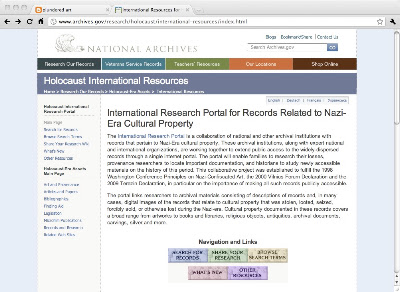
A newfangled “International Research Portal” has been launched to facilitate archival research on Nazi looting of art objects across Europe between 1933 and 1945. An official ceremony is scheduled to take place in Washington, DC, on May 5, 2011. The launch of the portal will be followed by an international conference on provenance research attended for the most part by museum professionals, provenance researchers, art experts.  Except for Lynn Nicholas and Patricia Grimsted who bring to the May 6-7, 2011, Provenance Research Conference, their respective focus on plunder of cultural objects, archives, and books, noted absences are those of pioneers of looted art research like Willi Korte and Konstantin Akinsha who blazed trails in the untangling of complex webs of illicit ownership of art objects in continental Europe.  Such is life…

The creation of this Portal is unprecedented.  It brings together through a common virtual gateway the archival holdings of the Bundesarchiv in Germany, the National Archives in the United States, the National Archives of the United Kingdom, the archives of the Ministry of Foreign Affairs of France, the Central State Archive of Supreme Bodies of Power and Government of Ukraine (TsDAVO), the State Archives of Belgium, the Munich Central Collecting Point and Linz databases, the Database of Art Objects at the Jeu de Paume, and the victims’ database of the “Memorial de la Shoah” in Paris, France.

Co-sponsors of this international effort include the Claims Conference and the Commission for Looted Art in Europe.

Of course, reality sets in quickly.  If one clicks on the link to the London-based Commission for Looted Art in Europe, the page that pops up offers us a link to the Nazi-Era Cultural Property Project.  Click on Search and one is prompted to enter search terms from which to retrieve documents. I typed “Jeu de Paume” and received 9 hits. I clicked on a prompt to obtain more details about the documents and at the bottom of the new page, I am prompted to place an order for the document in exchange for a fee. Sigh! The cost of doing business, I presume. This is the new age when research is no longer free.

The best part of the Portal  is the access to finding aids from 6 different archives and at least three looted art databases—Jeu de Paume, Munich Central Collecting Point and Linzmuseum—all essential tools for conducting complex research projects on Nazi-era plunder of cultural objects.

Who should get credit for all of this? By its very nature, the “International Research Portal” is the fruit of a lengthy negotiation between archives, governments, and non-profit organizations, in a half-dozen countries. The next step is to make sense of this overwhelming mass of records and to provide coherent, sensible road maps on how best to use them.

Please check out the research portal at http://www.archives.gov/research/holocaust/international-resources/.

Share
cameronav23
cameronav23

Related posts

January 9, 2020

What happened to the collection of Edouard Esmond?


Read more
January 5, 2020

The Destruction of works of art in wartime Paris-Part Two


Read more
January 3, 2020

The destruction of works of art in wartime Paris–Part One


Read more
Cookie Consent
We use cookies to optimize our website and our service.
Functional Always active
The technical storage or access is strictly necessary for the legitimate purpose of enabling the use of a specific service explicitly requested by the subscriber or user, or for the sole purpose of carrying out the transmission of a communication over an electronic communications network.
Preferences
The technical storage or access is necessary for the legitimate purpose of storing preferences that are not requested by the subscriber or user.
Statistics
The technical storage or access that is used exclusively for statistical purposes. The technical storage or access that is used exclusively for anonymous statistical purposes. Without a subpoena, voluntary compliance on the part of your Internet Service Provider, or additional records from a third party, information stored or retrieved for this purpose alone cannot usually be used to identify you.
Marketing
The technical storage or access is required to create user profiles to send advertising, or to track the user on a website or across several websites for similar marketing purposes.
Manage options Manage services Manage {vendor_count} vendors Read more about these purposes
Preferences
{title} {title} {title}