
by Verity Algar, co-posting with ARCAblog
The Holocaust Art Restitution Project and other organisations aiming to restitute Holocaust-looted art to its rightful owners justifiably propose restitution to be a positive thing in this context. However, my research has shown that not all cultural groups want to re-possess their cultural heritage.
I recently spoke at the Association of Research into Crimes Against Art’s 5th Annual Conference, where I compared these two objects:
 |
| Portrait of Adele Bloch-Bauer I by Gustav Klimt. (1907). Neue Galerie, New York. Source: Verity Algar |
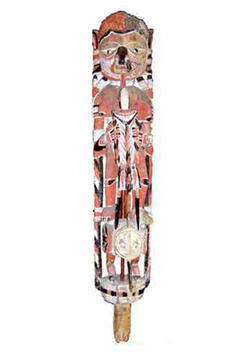 |
| Malanggan, from Northern New Ireland, Papua New Guinea. Collected in 1890. Museum of Archaeology & Anthropology, Cambridge Source: Verity Algar |
Why would I compare a twentieth-century European painting with a nineteenth-century wood carving from Melanesia, I hear you say?! Well, by comparing these different objects, I wanted to point out that their original owners take vastly different approaches to the restitution of these objects. Let me explain.
In Jewish communities, generally, the original owners of the cultural objects and/or their heirs, feel the need to re-claim their objects in order to gain a sense of closure on a traumatic past. As the following excerpts demonstrate, the language of restitution claims suggest that the Holocaust is not truly over until looted art objects have been restituted:
“The return of stolen art may be one of the last acts of the Shoah”
(Dellheim 2000 cited in Glass 2004: 117)
“museums … are dealing with the unfinished business of the Holocaust”
(editorial, Seattle Times 16 June 1999)
“Austria will move closer to closing the book on a somber chapter in 20th-century history”
(Czernin 1998 cited in Glass 2004: 118)
The people of New Ireland in Papua New Guinea, on the other hand, do not wish for the malanggan which they themselves created, to be returned to them, despite malanggan being essential to their culture. This may initially seem puzzling because they can often take more than three months to carve (Küchler 2002: 1). Yet they are not made to be displayed, treasured and revered as much of the art confiscated by the Nazis was. Malanggan are displayed for a few hours during mortuary ceremonies, before being left to the elements to decompose (Küchler and Melion 1991: 29). As money became increasingly important in New Ireland, the sale of malanggan to Western collectors became an attractive alternative (Küchler and Melion 1991: 29). More than five thousand malanggan have been collected by Western museums (Küchler and Melion 1991: 27). As other indigenous groups began to claim the objects that constituted their cultural memory from Western museums, the museums considered restituting the malanggan too.
This illustrates a fundamental misunderstanding of the significance of malanggan to Melanesian culture. During the carving process, the sculpture is imbued with life force, which is “symbolically killed” when ownership of the malanggan is transferred from the deceased’s family to related kin in exchange for money (Küchler and Melion 1991: 32). The image of the malanggan, however, is preserved as cultural memory and is reproduced in future sculptures (Küchler and Melion 1991: 32). Susanne Küchler and Walter Melion refer to the conflicting status of memory surrounding malanggan practice as “strategic remembering and deliberate forgetting” (1991: 30). To restitute these objects to the people of New Ireland would be to rekindle a specific aspect of their cultural memory, thus interfering with the process of “deliberate forgetting”.
Whilst it is fundamentally important that organisations such as ARCA and HARP continue to support research into Holocaust-era looted art, it is equally important that we understand why restitution can be incredibly problematic for some groups of people. Far from interrupting or countering my pro-restitution tendency, the argument against the restitution of malanggan can run alongside this tendency. As a concept, restitution is neither good nor bad. Rather, decisions about whether or not to restitute cultural objects need to be made on a culture-specific basis.
Verity Algar is a second year BA in History of Art student at University College London, where she minors in Anthropology. She recently spoke on ‘Cultural memory and the restitution of cultural property: Comparing Nazi-looted art and Melanesian malanggan’ at the Association of Research into Crimes Against Art’s 5th Annual Conference. She is hoping to complete the ARCA Postgraduate Certificate before working in a field relating to cultural heritage protection.