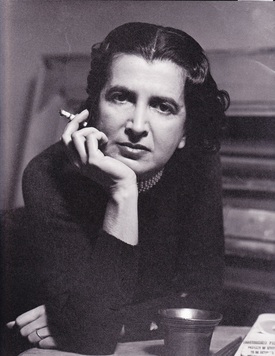
by Marc Masurovsky
 |
| Source: NARA |
On December 3, 2007, Christie’s Paris sold a painting by Marie Laurencin, entitled “L’embarcadère’ [Haut de Porte].” As is usual with Laurencin’s works, the subjects that she depicts consist for the most part of ethereal-looking women painted in wispy, light colors, gazing and poised.
This particular painting was produced in 1927 and was once the property of Paul Rosenberg, the late French Jewish art dealer with the keenest eye for the highest quality that one could muster in terms of 19th and early 20th century French modern art. It is not an exaggeration to say that most of the paintings, works on paper and sculptures that Rosenberg collected and sold were of museum quality. His legacy stretches across a global network of museums, galleries, and private collections.
In June 1940, the German Army overtook France in a classical blitzkrieg operation, catching the French army sleeping in the fields—literally. Rosenberg had the presence of mind to redistribute in lots of varying importance his vast collection of works and objects of art across depots in Tours, Bordeaux, and Floirac and a bank vault in Libourne.
Denounced by art dealing rivals in Paris anxious to gain access to some of his objects, the depots as well as his residence and gallery in Paris were quickly overrun by German agents and their trusted Frenchmen, the works confiscated and brought back to the Jeu de Paume for processing. Among the dozens of Laurencin works which fell into German hands, was “L’embarcadère”. At the time of seizure it was simply referred to as a “dessus de porte”, a painting that one places as a decorative item above a door frame. The title that the Germans eventually gave it is a literal evocation of what they observed on the canvas: “Zwei Mädchen im Boot und zwei auf einer Treppe” (two women in a boat and two on a landing). After it was brought to the Jeu de Paume and catalogued the Germans assigned to the painting the alphanumeric code “Rosenberg-Bernstein-Bordeaux 9.”
The provenance in the Christie’s catalogue indicates:
Paul Rosenberg & Co., New York (no. 1915).
Paul et Marguerite Rosenberg, Paris.
“Puis par descendance au propriétaire actuel” [thence by descent to the current owner]
The historical provenance would include the following pertinent facts:
Confiscated either in Floirac or in Paris, 1940-1941
Removed to the Jeu de Paume, by 1941
Inventoried by the ERR as Rosenberg-Bernstein-Bordeaux 9
Placed by the ERR on a train bound for Nikolsburg, 1 August 1944
Intercepted by French forces
Restituted to Paul Rosenberg, 25 September 1945.
 |
| Photograph taken by the ERR in 1941, Koblenz Archives |