 |
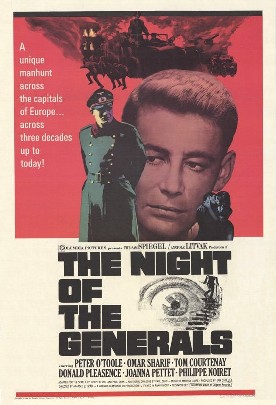
| Night of the Generals 1967 Movie Poster Source: IMPAwards |
One particular scene attracted my attention. Peter O’Toole’s character, SS General Tanz, visits the Jeu de Paume in the Jardin des Tuileries, courtesy of the German General Staff in occupied Paris. He is offered a private tour of the art looted from Jewish households, which has been stored there before being shipped to Germany.
It would all be fine except that we are now on July 18, 1944. Most of the art looted by the Germans and taken to the Jeu de Paume for processing had already been either sent to the Reich for dispersal or incorporation into either the future Linz Museum collection or other State or private collections, or been disposed of on the Paris art market.
SS General Tanz is taken into a private room protected by a curtain that cloaks a metal gate. Behind the curtain and the gate is a room where ‘decadent’ works are stored, as they called them in the film.
This is where it gets curious. Lance Corporal Hartmann (played by Tom Courtenay) who accompanies SS General Tanz has a ledger in hand from which he describes each painting that Tanz reviews. How extraordinary! especially since such an ‘exhibit’ ledger did not exist. Nevertheless, we see reproductions of paintings by Toulouse-Lautrec (Le Divan), a nude by Renoir which he painted in 1910, Paul Gauguin’s “On the Beach,” and, most amazingly a painting by Chaim Soutine described as ‘Le Garcon d’Etage [the Bellboy]’, Edgar Degas’ ‘The Tub” painted in 1886. I would stop here were it not for the self-portrait by Van Gogh, sometimes called “Vincent in Flames” which entrances General Tanz who almost goes into convulsions so hypnotic is the work.
Were these paintings ever at the Jeu de Paume? I checked the ERR database at www.errproject.org/jeudepaume, on the off-chance that they might be listed there.
None of them are and the Degas looked more like a Bonnard.
The Van Gogh does not appear to exist either.
Why take such license when there were so many great works to choose from, reproduce and display?
The only truth to the story is that many such ‘decadent’ works had been prepared for shipment to a castle in present-day Czech Republic at Nikolsburg/Mikulov on August 1, 1944. The train barely made it out of Paris and was stopped by the French resistance near a small town called Aulnay-sous-Bois. On that train were a trove of Impressionist works which the rightful owners recovered in due course.
 |
| The Train, 1964 Source: imdb |
The subject of that dramatic story is treated in yet another film aptly called ‘The Train’ by John Frankenheimer, made in 1964, with Burt Lancaster in the starring role.
Epilogue
SS General Tanz is set to leave the ‘decadent’ room–in the film, it is labeled ‘Salle E’, while in the actual history of the Jeu de Paume, it is referred to as the ‘Salle des Martyrs.” On his way, he picks up what look like flyers from a stack on a table. These are reproductions of some of the paintings that he just looked at, as if the Nazis had organized the room in true exhibit form complete with photo-reproductions that one could take home and admire. Photos of ‘decadent’ works? How strange! But then, life is stranger than fiction, non?