
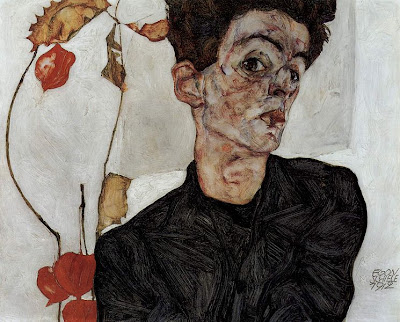
 |
| Self-Portrait, by Egon Schiele, 1912 Source: Google Images |
No, it’s not what it sounds like. I did not spend a wild weekend with Wally.
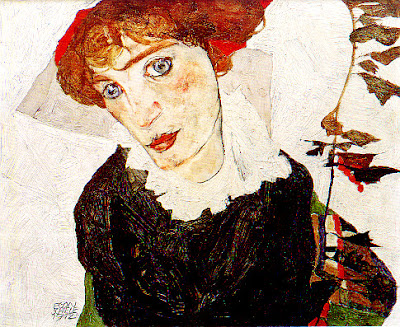 |
| Portrait of Wally, by Egon Schiele, 1912 Source: Google Images |
The Wally in question is “The Portrait of Wally”, a new documentary which was screened at the TriBeCa Film Festival in New York, on April 28 and 29, 2012, and directed by Andrew Shea and co-produced by David D’Arcy and Barbara Morgan. Morgan and Shea hail from Austin, TX. D’Arcy is a veteran reporter, formerly affiliated with National Public Radio (NPR) who has filed many stories about the international art market especially in regard to looted art in American collections.
The Wally of which we speak is the now-iconic portrait of a Viennese woman, Walburga Neuzil, who was the mistress of the man who painted her, Egon Schiele. The painting dates from 1912. Schiele created it as a pendant to a self-portrait executed that same year, six years before his untimely death caused by the Spanish flu. Both works currently hang on the walls of the Leopold Museum in Vienna, Austria.
And that is the end of the story.
There would have been no “Wally Story” had this Schiele painting not been stolen from its rightful owner, Lea Bondi Jarai, a Viennese Jewish gallery owner.
 |
| Lea Bondi Jarai Source: ArtsJournal |
The thief was a self-avowed Nazi art collector and dealer, Friedrich Welz, who had become emboldened by the March 1938 Anchluss-the willing absorption of Austria into Hitler’s Greater German Reich. This would have been yet another story of Nazi thefts of cultural assets belonging to Jews had it not been for an unscrupulous art dealer and collector named Rudolf Leopold, who with his wife, Elisabeth, built up one of the world’s largest postwar collections of works by Egon Schiele, a collection that verges on idolatry and self-aggrandizing fetishism. By the time the Leopolds had “acquired” Wally through an illegal exchange with a leading Viennese museum in the 1950s, Lea was living in exile in London where she had resumed her art trading activities. She died in 1969, heartbroken at not having recovered the painting which she continually sought in the postwar years, pleading with Leopold to help her. Unbeknownst to her, Leopold now possessed it, despite the lies that he had spewed at her to disguise his machinations aimed at deceiving her so as to be able to acquire Wally and make her his to possess forever.
 |
| Rudolf Leopold Source: The Arts Newspaper |
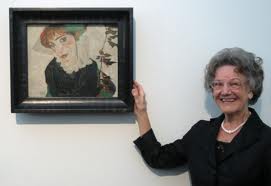 |
| Elisabeth Leopold Source: Google Images |
The story could have just ended there in all of its sordid details, a story of unremitting greed and lust displayed by a Viennese couple enraptured with Schiele’s works, who had openly flirted with and benefited from the Nazi years and the postwar continuum of Nazi influence in Austrian society, taking full advantage of the plight of Viennese Jews to build up their Schiele collection, revered the world over, in particular by American collectors and dealers, most explicitly those centered in New York City.
The official story of what we have come to know as the Wally Case entered its prelude in October 1997 when the Leopold Museum exhibited its treasures at the Museum of Modern Art, whose chairman, Ronald Lauder, was a self-admitted Schiele fan and collector. Needless to say, the exhibit was a success but the presence of Wally on its walls ruined it all for MoMA, for its director, Glenn Lowry, for Leopold, and especially for the Bondi family, next of kin of Lea Bondi Jaraj, who had discovered that the painting was in the United States exhibited under their very noses, with a provenance worthy of a second-rate work of fiction—no mention of Lea’s true ownership of the work, a fictitious sequence of individuals who had nothing to do with the painting’s pedigree. But, as we know, provenances, more often than not, are mere adornments, however fanciful they might be.
 |
| Willi Korte Source: Zimbio |
The “Wally case” began after the Bondis attempted to clarify the true ownership of the work and failed to convince MoMA’s leadership and Leopold to engage in a dialogue over the ownership of the painting so as to determine its fate. After numerous futile attempts, MoMA invited the Bondi heirs to sue them in order to prevent the painting from leaving the US and returning to Vienna where there would have been no “fair hearing.”
Willi Korte, veteran researcher, historian, jurist and investigator of looted cultural property and a co-founder of the Holocaust Art Restitution Project (HARP) helped Henri Bondi get his research ducks in order to prepare for a full-frontal campaign to get Wally back. Others like Marc Masurovsky, Ori Soltes and their legal counsel, Jeanine Benton, also of HARP, were urging Senate Banking Committee staff, Jewish organizations and law enforcement agencies to step into the breach and do “something” to keep the painting in the US.
By early January 1998, it didn’t look good. After Senator D’Amato demanded the seizure of the collection, he recused himself almost as dramatically, having received a phone call from one of his most ardent campaign donors who asked him to reconsider his rash statement. And so he did. US Customs—now ICE—in the person of Special Agent Bonnie Goldblatt were ready to pounce but were left out in the cold because of D’Amato’s sudden withdrawal and the equally callous abandonment by other Federal officials at State and Commerce who had ruled that this was indeed a private matter which should not require official American governmental interference that might intrude on the good relations between the United States and Austria.
 |
| Special Agent Bonnie Goldblatt Source: ArtsJournal |
 |
| Robert Morgenthau Source: Google Images |
All this to say that all five of us were rather alone that first week of January, dismayed at the cowardice displayed by elected and appointed officials alike, the cynicism of the art world, and the apparent indifference of American Jewish groups including the World Jewish Congress and the American Jewish Committee, who refused to lift a finger on behalf of the Bondis, the legitimate heirs of a victim of Nazi persecution. Is it a coincidence that the chairman of the board of MoMA was also the secretary-treasurer of the WJC? We’ll leave that alone for now…
The last hope was Robert Morgenthau, District Attorney of Manhattan. He emerged as the ultimate mensch of the Wally story, consistent with his lineage—a grandfather, Harry, who had blown the whistle on Ottoman massacres of Armenian civilians in 1915 before resigning as a foreign service official during President Wilson’s tenure; a father, Henry, Treasury Secretary under Franklin Roosevelt (FDR) and the most ardent anti-Nazi member in FDR’s government—its only “cabinet Jew.”
HARP forwarded a set of documents to Morgenthau’s office before and after New Year’s of 1998 outlining the weaknesses of MoMA and Leopold’s position—in their haste to exhibit the Schiele works, MoMA and Leopold had forgotten to “immunize” or shield the collection against any possibility of legal challenges arising from claims to rightful ownership while the works were on display in the United States—a foreshadowing of the proposed Senate Bill 2212 currently stalled in the Senate Judiciary Committee. The paintings were thus vulnerable to any legal action taken against them on US territory, especially arising out of a claim of rightful ownership. For Morgenthau, the presence of stolen property in his jurisdiction was, in his own words, “unacceptable.”
During that first week of January 1998, the skies were bleak, the prospect of a fair hearing for the Bondi heirs seemed more like a remote fantasy than an impending reality. With no one left to uphold their interests, MoMA and Leopold were about to breathe a sigh of relief, except that they did not factor in the unlikely and outrageous possibility that something drastic might just prevent the paintings from leaving the United States. On January 7, 1998, Morgenthau obtained the necessary legal instruments by which to order the seizure of Wally and another painting, Dead City III, until the ownership of these works could be clarified. The men in blue entered MoMA’s front doors on 53rd Street and made arrangements to have Wally and Dead City III sequestered. For the first time in recent memory, an American official had directly intervened with a cultural event in an American museum by ordering the seizure of works on loan for display there.
End of Part One.