
At a time when one French Jewish family is beating its head against a brick wall to recover a painting by John Constable, “Dedham from Langham”, from the Museum of Fine Arts in La Chaux-de-fonds, in the French-speaking part of Switzerland, a country whose officials revere Good Faith on the altar of Neutrality. A joke, by any stretch of the imagination.
 |
| Dedham from Langham, by John Constable |
This is the only known claim today submitted by a non-Swiss citizen of Jewish descent for a work of art sold under duress in German-occupied France in 1943 because its owners—the Jaffe family—were of Jewish descent.
In the mean time, the Swiss government has been returning a host of antiquities to foreign nations requesting them:
 May 27, 2014: The Swiss government returned to Serbia a trove of 150 coins dating back to the Roman era. The crime? Illegal importation into Switzerland by a Serb national in 2011.
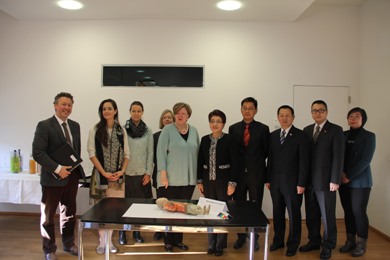 December 2014: The Swiss government returns a Han Dynasty terra cotta to China. The crime? Forged customs declaration. The item had been shipped from the United Kingdom to the county of Vaud. This restitution was hailed as a major step in the fight against the illicit traffic in cultural assets.
November 2015: The Swiss government returned to the Iraqi government two cuneiform tablets on the pretext that they had not been properly registered as “cultural goods” when entering Switzerland. The crime here? False registration in violation of a June 1, 2005, law governing the transfer of international cultural goods.
July 2016: The Swiss government returned to Italy nine antiquities including five fresco fragments from the 6th century BC. The fresco fragments which come from Pompeii resulted from a voluntary restitution by their current possessor. Swiss cantonal police seized the other items.
Pending: a request by the Bolivian government for a statuette representing the deity, Ekeko, removed from Bolivia in 1858, the result of a drunken swap, a statuette for a bottle of brandy. The statuette currently sits at the History Museum of Bern.
It is remarkable that the new minister of Culture of the Swiss Confederation, Isabelle Chassot, is so committed to the return of cultural objects that are illegally in Switzerland.
This is not a whining session.
We know what the stark differences are. There are no laws covering the return of looted Jewish cultural assets. But there are a myriad of laws enacted in the last 20 years that make it very difficult to sustain the presence of looted cultural assets on Swiss territory.
Hopefully, Isabelle Chassot will figure out a way of making an ethically grounded exception to facilitate the return of looted Jewish cultural assets.